You are viewing a plain text version of this content. The canonical link for it is here.
Posted to commits@mxnet.apache.org by GitBox <gi...@apache.org> on 2018/07/03 22:06:14 UTC
[GitHub] thomelane commented on a change in pull request #11304: [MXNET-594]
Added Learning Rate Finder tutorial
thomelane commented on a change in pull request #11304: [MXNET-594] Added Learning Rate Finder tutorial
URL: https://github.com/apache/incubator-mxnet/pull/11304#discussion_r199958663
##########
File path: docs/tutorials/gluon/learning_rate_finder.md
##########
@@ -0,0 +1,322 @@
+
+# Learning Rate Finder
+
+Setting the learning rate for stochastic gradient descent (SGD) is crucially important when training neural network because it controls both the speed of convergence and the ultimate performance of the network. Set the learning too low and you could be twiddling your thumbs for quite some time as the parameters update very slowly. Set it too high and the updates will skip over optimal solutions, or worse the optimizer might not converge at all!
+
+Leslie Smith from the U.S. Naval Research Laboratory presented a method for finding a good learning rate in a paper called ["Cyclical Learning Rates for Training Neural Networks"](https://arxiv.org/abs/1506.01186). We take a look at the central idea of the paper, cyclical learning rate schedules, in the tutorial called 'Advanced Learning Rate Schedules', but in this tutorial we implement a 'Learning Rate Finder' in MXNet with the Gluon API that you can use while training your own networks.
+
+## Simple Idea
+
+Given an initialized network, a defined loss and a training dataset we take the following steps:
+
+1. train one batch at a time (a.k.a. an iteration)
+2. start with a very small learning rate (e.g. 0.000001) and slowly increase it every iteration
+3. record the training loss and continue until we see the training loss diverge
+
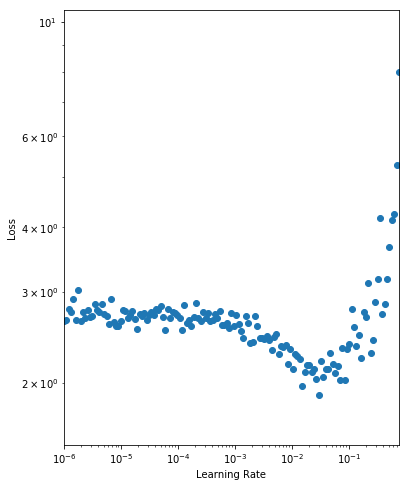
+We then analyse the results by plotting a graph of the learning rate against the training loss as seen below (taking note of the log scales).
+
+ <!--notebook-skip-line-->
+
+As expected, for very small learning rates we don't see much change in the loss as the parameter updates are negligible. At a learning rate of 0.001, we start to see the loss fall. Setting the initial learning rate here is reasonable, but we still have the potential to learn faster. We observe a drop in the loss up until 0.1 where the loss appears to diverge. We want to set the initial learning rate as high as possible before the loss becomes unstable, so we choose a learning rate of 0.05.
+
+## Epoch to Iteration
+
+Usually, our unit of work is an epoch (a full pass through the dataset) and the learning rate would typically be held constant throughout the epoch. With the Learning Rate Finder (and cyclical learning rate schedules) we are required to vary the learning rate every iteration. As such we structure our training code so that a single iteration can be run with a given learning rate. You can implement Learner as you wish. Just initialize the network, define the loss and trainer in `__init__` and keep your training logic for a single batch in `iteration`.
+
+
+```python
+import mxnet as mx
+
+# Set seed for reproducibility
+mx.random.seed(42)
+
+class Learner():
Review comment:
Me neither, but going to leave to avoid confusion with the videos that have been recorded.
----------------------------------------------------------------
This is an automated message from the Apache Git Service.
To respond to the message, please log on GitHub and use the
URL above to go to the specific comment.
For queries about this service, please contact Infrastructure at:
users@infra.apache.org
With regards,
Apache Git Services