You are viewing a plain text version of this content. The canonical link for it is here.
Posted to commits@pulsar.apache.org by GitBox <gi...@apache.org> on 2020/07/02 06:30:48 UTC
[GitHub] [pulsar] Jennifer88huang commented on a change in pull request #7421: [pulsar-doc] Add document for Pulasr SNI routing with ATS
Jennifer88huang commented on a change in pull request #7421:
URL: https://github.com/apache/pulsar/pull/7421#discussion_r448769731
##########
File path: site2/docs/concepts-proxy-sni-routing.md
##########
@@ -0,0 +1,117 @@
+---
+id: concepts-proxy-sni-routing
+title: Proxy support with SNI routing
+sidebar_label: Proxy support with SNI routing
+---
+
+# Pulsar Proxy with SNI routing
+
+A proxy server is a go‑between or intermediary server that forwards requests from multiple clients to different servers across the Internet. The proxy server can act as a “traffic cop,” in both forward and reverse proxy scenarios, and adds various benefits in your system such as load balancing, performance, security, auto-scaling, etc.. There are already many proxy servers already available in the market which are fast, scalable and more importantly covers various essential security aspects that are needed by the large organization to securely share their confidential data over the network. Pulsar already provides proxy implementation which acts as a reverse proxy and creates a gateway in front of brokers. However, pulsar doesn’t provide support to use other proxies such as Apache traffic server (ATS), HAProxy, Nginx, Envoy those are more scalable and secured. Most of these proxy-servers support SNI ROUTING which can route traffic to a destination without having to terminate the SSL connection. Routing at layer 4 gives greater transparency because the outbound connection is determined by examining the destination address in the client TCP packets.
+
+[PIP-60](https://github.com/apache/pulsar/wiki/PIP-60:-Support-Proxy-server-with-SNI-routing) eexplains SNI routing protocol and how Pulsar clients support SNI routing protocol to connect to brokers via proxy. This document explains how to setup ATS proxy and pulsar-client to enable SNI routing and connect pulsar-client to pulsar-broker via ATS proxy.
+
+## ATS-SNI Routing in Pulsar
+[ATS supports layer-4 SNI routing](https://docs.trafficserver.apache.org/en/latest/admin-guide/layer-4-routing.en.html) with requirement that inbound connection must be TLS. Pulsar client supports SNI routing protocol and we can use ATS proxy in front of brokers, so pulsar client can connect to broker via ATS proxy. Pulsar also supports SNI routing for geo-replication, so brokers can connect to cross cluster brokers via ATS proxy.
Review comment:
1. I did not get the meaning of the first sentence.
2. Try to use the second person when writing technical document, see https://developers.google.com/style/person
3. Try not use modal verbs like "can" to avoid ambiguity. "Can" have two meanings:
a. be able to do sth
b. the possibility to do sth
##########
File path: site2/docs/concepts-proxy-sni-routing.md
##########
@@ -0,0 +1,117 @@
+---
+id: concepts-proxy-sni-routing
+title: Proxy support with SNI routing
+sidebar_label: Proxy support with SNI routing
+---
+
+# Pulsar Proxy with SNI routing
+
+A proxy server is a go‑between or intermediary server that forwards requests from multiple clients to different servers across the Internet. The proxy server can act as a “traffic cop,” in both forward and reverse proxy scenarios, and adds various benefits in your system such as load balancing, performance, security, auto-scaling, etc.. There are already many proxy servers already available in the market which are fast, scalable and more importantly covers various essential security aspects that are needed by the large organization to securely share their confidential data over the network. Pulsar already provides proxy implementation which acts as a reverse proxy and creates a gateway in front of brokers. However, pulsar doesn’t provide support to use other proxies such as Apache traffic server (ATS), HAProxy, Nginx, Envoy those are more scalable and secured. Most of these proxy-servers support SNI ROUTING which can route traffic to a destination without having to terminate the SSL connection. Routing at layer 4 gives greater transparency because the outbound connection is determined by examining the destination address in the client TCP packets.
+
+[PIP-60](https://github.com/apache/pulsar/wiki/PIP-60:-Support-Proxy-server-with-SNI-routing) eexplains SNI routing protocol and how Pulsar clients support SNI routing protocol to connect to brokers via proxy. This document explains how to setup ATS proxy and pulsar-client to enable SNI routing and connect pulsar-client to pulsar-broker via ATS proxy.
Review comment:
```suggestion
[PIP-60](https://github.com/apache/pulsar/wiki/PIP-60:-Support-Proxy-server-with-SNI-routing) explains SNI routing protocol and how Pulsar clients support SNI routing protocol to connect to brokers via proxy. This document explains how to setup ATS proxy and pulsar-client to enable SNI routing and connect pulsar-client to pulsar-broker via ATS proxy.
```
##########
File path: site2/docs/concepts-proxy-sni-routing.md
##########
@@ -0,0 +1,117 @@
+---
+id: concepts-proxy-sni-routing
+title: Proxy support with SNI routing
+sidebar_label: Proxy support with SNI routing
+---
+
+# Pulsar Proxy with SNI routing
+
+A proxy server is a go‑between or intermediary server that forwards requests from multiple clients to different servers across the Internet. The proxy server can act as a “traffic cop,” in both forward and reverse proxy scenarios, and adds various benefits in your system such as load balancing, performance, security, auto-scaling, etc.. There are already many proxy servers already available in the market which are fast, scalable and more importantly covers various essential security aspects that are needed by the large organization to securely share their confidential data over the network. Pulsar already provides proxy implementation which acts as a reverse proxy and creates a gateway in front of brokers. However, pulsar doesn’t provide support to use other proxies such as Apache traffic server (ATS), HAProxy, Nginx, Envoy those are more scalable and secured. Most of these proxy-servers support SNI ROUTING which can route traffic to a destination without having to terminate the SSL connection. Routing at layer 4 gives greater transparency because the outbound connection is determined by examining the destination address in the client TCP packets.
Review comment:
```suggestion
A proxy server is a go‑between or intermediary server that forwards requests from multiple clients to different servers across the Internet. The proxy server acts as a “traffic cop,” in both forward and reverse proxy scenarios, and adds various benefits in your system such as load balancing, performance, security, auto-scaling, etc.. There are already many proxy servers already available in the market which are fast, scalable and more importantly covers various essential security aspects that are needed by the large organization to securely share their confidential data over the network. Pulsar provides proxy implementation which acts as a reverse proxy and creates a gateway in front of brokers. However, pulsar doesn’t provide support to use other proxies such as Apache traffic server (ATS), HAProxy, Nginx, Envoy those are more scalable and secured. Most of these proxy-servers support SNI ROUTING which can route traffic to a destination without having to terminate the SSL connection. Routing at layer 4 gives greater transparency because the outbound connection is determined by examining the destination address in the client TCP packets.
```
##########
File path: site2/docs/concepts-proxy-sni-routing.md
##########
@@ -0,0 +1,117 @@
+---
+id: concepts-proxy-sni-routing
+title: Proxy support with SNI routing
+sidebar_label: Proxy support with SNI routing
+---
+
+# Pulsar Proxy with SNI routing
+
+A proxy server is a go‑between or intermediary server that forwards requests from multiple clients to different servers across the Internet. The proxy server can act as a “traffic cop,” in both forward and reverse proxy scenarios, and adds various benefits in your system such as load balancing, performance, security, auto-scaling, etc.. There are already many proxy servers already available in the market which are fast, scalable and more importantly covers various essential security aspects that are needed by the large organization to securely share their confidential data over the network. Pulsar already provides proxy implementation which acts as a reverse proxy and creates a gateway in front of brokers. However, pulsar doesn’t provide support to use other proxies such as Apache traffic server (ATS), HAProxy, Nginx, Envoy those are more scalable and secured. Most of these proxy-servers support SNI ROUTING which can route traffic to a destination without having to terminate the SSL connection. Routing at layer 4 gives greater transparency because the outbound connection is determined by examining the destination address in the client TCP packets.
+
+[PIP-60](https://github.com/apache/pulsar/wiki/PIP-60:-Support-Proxy-server-with-SNI-routing) eexplains SNI routing protocol and how Pulsar clients support SNI routing protocol to connect to brokers via proxy. This document explains how to setup ATS proxy and pulsar-client to enable SNI routing and connect pulsar-client to pulsar-broker via ATS proxy.
+
+## ATS-SNI Routing in Pulsar
+[ATS supports layer-4 SNI routing](https://docs.trafficserver.apache.org/en/latest/admin-guide/layer-4-routing.en.html) with requirement that inbound connection must be TLS. Pulsar client supports SNI routing protocol and we can use ATS proxy in front of brokers, so pulsar client can connect to broker via ATS proxy. Pulsar also supports SNI routing for geo-replication, so brokers can connect to cross cluster brokers via ATS proxy.
+
+### ATS Proxy setup for layer-4 SNI routing
+
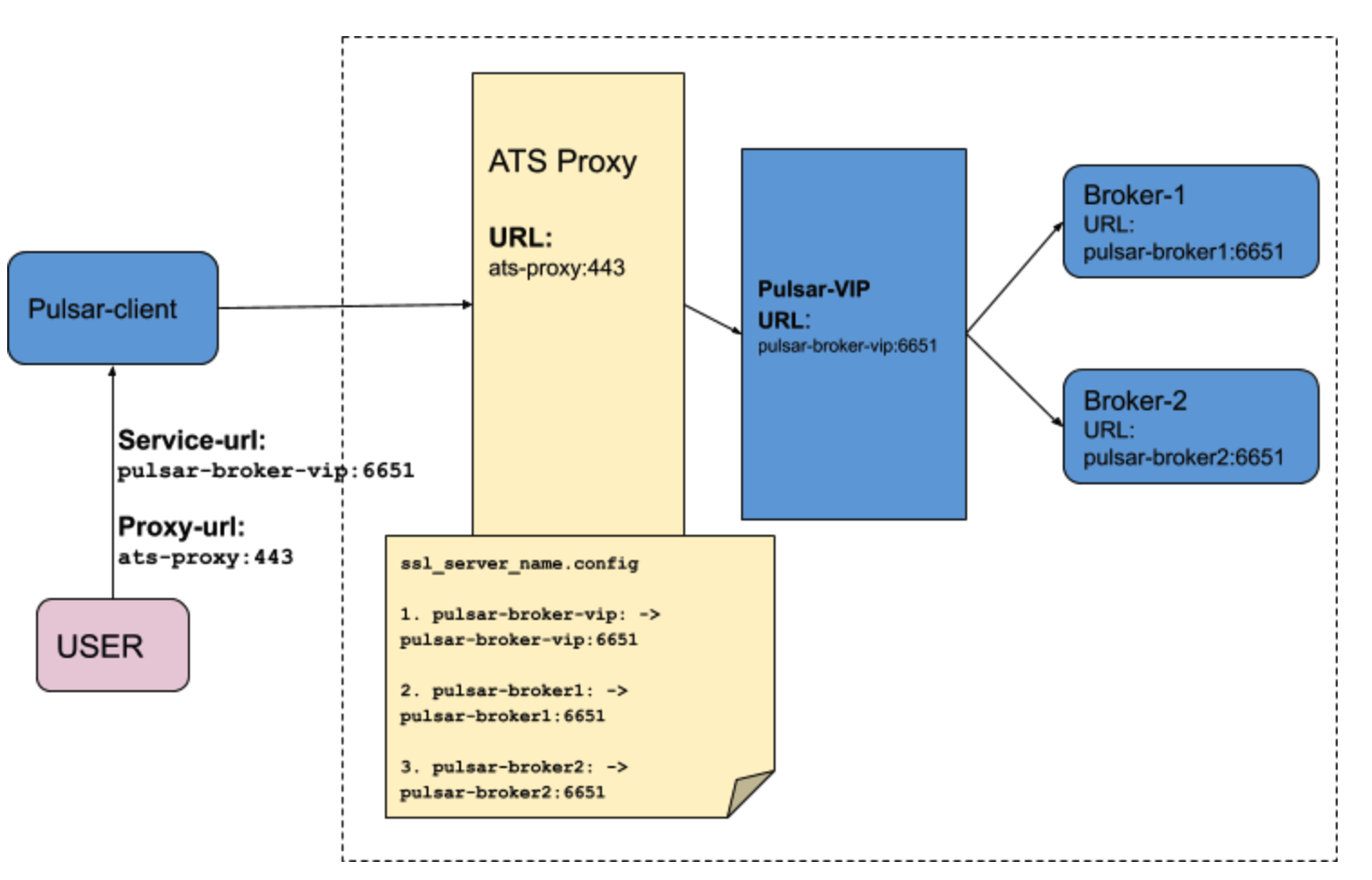
+This section explains ATS-setup to enable layer-4 SNI routing and use ATS proxy as a forward proxy where the pulsar broker runs behind the ATS proxy and client connects to pulsar-broker through this ATS proxy.
+
+
+
+
+We have to configure two conf files into ATS proxy to support SNI routing.
Review comment:
```suggestion
To support SNI routing, you need to xxx.
```
##########
File path: site2/docs/concepts-proxy-sni-routing.md
##########
@@ -0,0 +1,117 @@
+---
+id: concepts-proxy-sni-routing
+title: Proxy support with SNI routing
+sidebar_label: Proxy support with SNI routing
+---
+
+# Pulsar Proxy with SNI routing
+
+A proxy server is a go‑between or intermediary server that forwards requests from multiple clients to different servers across the Internet. The proxy server can act as a “traffic cop,” in both forward and reverse proxy scenarios, and adds various benefits in your system such as load balancing, performance, security, auto-scaling, etc.. There are already many proxy servers already available in the market which are fast, scalable and more importantly covers various essential security aspects that are needed by the large organization to securely share their confidential data over the network. Pulsar already provides proxy implementation which acts as a reverse proxy and creates a gateway in front of brokers. However, pulsar doesn’t provide support to use other proxies such as Apache traffic server (ATS), HAProxy, Nginx, Envoy those are more scalable and secured. Most of these proxy-servers support SNI ROUTING which can route traffic to a destination without having to terminate the SSL connection. Routing at layer 4 gives greater transparency because the outbound connection is determined by examining the destination address in the client TCP packets.
+
+[PIP-60](https://github.com/apache/pulsar/wiki/PIP-60:-Support-Proxy-server-with-SNI-routing) eexplains SNI routing protocol and how Pulsar clients support SNI routing protocol to connect to brokers via proxy. This document explains how to setup ATS proxy and pulsar-client to enable SNI routing and connect pulsar-client to pulsar-broker via ATS proxy.
+
+## ATS-SNI Routing in Pulsar
+[ATS supports layer-4 SNI routing](https://docs.trafficserver.apache.org/en/latest/admin-guide/layer-4-routing.en.html) with requirement that inbound connection must be TLS. Pulsar client supports SNI routing protocol and we can use ATS proxy in front of brokers, so pulsar client can connect to broker via ATS proxy. Pulsar also supports SNI routing for geo-replication, so brokers can connect to cross cluster brokers via ATS proxy.
+
+### ATS Proxy setup for layer-4 SNI routing
+
+This section explains ATS-setup to enable layer-4 SNI routing and use ATS proxy as a forward proxy where the pulsar broker runs behind the ATS proxy and client connects to pulsar-broker through this ATS proxy.
Review comment:
It would be better if you can write clear and concise sentences, it's easy to read and understand.
Avoid writing long-winded sentences, see https://developers.google.com/style/tone#some-things-to-avoid-where-possible
##########
File path: site2/docs/concepts-proxy-sni-routing.md
##########
@@ -0,0 +1,117 @@
+---
+id: concepts-proxy-sni-routing
+title: Proxy support with SNI routing
+sidebar_label: Proxy support with SNI routing
+---
+
+# Pulsar Proxy with SNI routing
+
+A proxy server is a go‑between or intermediary server that forwards requests from multiple clients to different servers across the Internet. The proxy server can act as a “traffic cop,” in both forward and reverse proxy scenarios, and adds various benefits in your system such as load balancing, performance, security, auto-scaling, etc.. There are already many proxy servers already available in the market which are fast, scalable and more importantly covers various essential security aspects that are needed by the large organization to securely share their confidential data over the network. Pulsar already provides proxy implementation which acts as a reverse proxy and creates a gateway in front of brokers. However, pulsar doesn’t provide support to use other proxies such as Apache traffic server (ATS), HAProxy, Nginx, Envoy those are more scalable and secured. Most of these proxy-servers support SNI ROUTING which can route traffic to a destination without having to terminate the SSL connection. Routing at layer 4 gives greater transparency because the outbound connection is determined by examining the destination address in the client TCP packets.
+
+[PIP-60](https://github.com/apache/pulsar/wiki/PIP-60:-Support-Proxy-server-with-SNI-routing) eexplains SNI routing protocol and how Pulsar clients support SNI routing protocol to connect to brokers via proxy. This document explains how to setup ATS proxy and pulsar-client to enable SNI routing and connect pulsar-client to pulsar-broker via ATS proxy.
+
+## ATS-SNI Routing in Pulsar
+[ATS supports layer-4 SNI routing](https://docs.trafficserver.apache.org/en/latest/admin-guide/layer-4-routing.en.html) with requirement that inbound connection must be TLS. Pulsar client supports SNI routing protocol and we can use ATS proxy in front of brokers, so pulsar client can connect to broker via ATS proxy. Pulsar also supports SNI routing for geo-replication, so brokers can connect to cross cluster brokers via ATS proxy.
Review comment:
what does "in front of brokers" mean?
----------------------------------------------------------------
This is an automated message from the Apache Git Service.
To respond to the message, please log on to GitHub and use the
URL above to go to the specific comment.
For queries about this service, please contact Infrastructure at:
users@infra.apache.org